
Updates from Our Students Taking Coral Reef Structure & Function!
We’ve heard from two first-year master’s students who are currently participating in the course and have shared their experiences during their stay.
Learning about Marine Ecosystems in the Field (Updated on Oct 19)
During the second week of the course, we gained hands-on experience collecting data on coral reefs in the field. Conducting fieldwork amid strong waves was much more difficult than I had expected. However, observing the coral reefs and the diverse organisms living there firsthand allowed me to connect what I had learned in lectures with the actual environment, deepening my understanding of the material. We then analyzed the collected data and visualized the correlations between the measured variables. Through this process, I realized that combining direct field observations with data analysis can lead to a deeper understanding of the environment. We also created artificial structures called “modules” that provide habitats for marine organisms by using a 3D printer. Through the experience of turning three-dimensional designs into physical structures, I became more interested in understanding how habitat structure influences the environment and organisms living in it.
In my graduate research, I study the effects of climate change on phytoplankton. Through this program, I realized that understanding marine ecosystems requires not only studying the relationships between organisms and their environment in the laboratory, but also experiencing the marine environment firsthand. Experiencing the process of working together to collect data while immersing myself in nature gave me an opportunity to reflect on the regions and environments connected to my research and the impact it may have on them. My experiences in Hokkaido and Hawaii have broadened my perspective on marine ecosystems.
Kokori Harayama
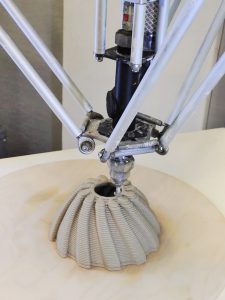
Creating a structure (module) using a 3D printer
~ ~ ~ ~ ~ ~ ~ ~ ~ ~ ~ ~
3D Scanning and Analysis Using R (Updated on Oct 14)
Although corals are living organisms, they form complex structures known as coral reefs. These structures provide habitats, spawning grounds, and nurseries for a wide variety of marine organisms, thereby supporting rich biodiversity.
During the first week of classes, we used laser scanning technology to quantify coral morphology. In just about five minutes of scanning a coral, a high-resolution 3D model was successfully generated and displayed on the screen. Furthermore, by analyzing the obtained 3D data using the statistical software R, we calculated key morphological parameters, including surface area, volume, and fractal dimension.
In upcoming sessions, we will use these measured parameters to identify the environmental conditions required for the settlement or survival of target organisms, and then design and create clay habitat modules. Through these activities, we will explore an ecological engineering approach to creating optimal habitats and environments tailored to the needs of target organisms.
Rikuto Matsuo
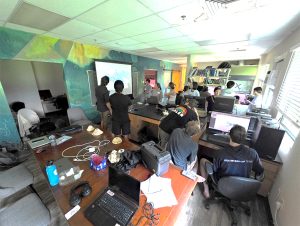
Processing 3D Laser Scan Data from a Coral Sample (Photo by Guan-Yan Chen)
~ ~ ~ ~ ~ ~ ~ ~ ~ ~ ~ ~
(Updated on Oct 1)
Kokori Harayama and Rikuto Matsuo, graduate students from the Graduate School of Fisheries Sciences, have arrived in Hawaiʻi to participate in “Coral Reef Structure & Function (MBIO 640)”, an exchange program offered by the University of Hawaiʻi (UH).
On their first day, they visited the UH Mānoa Campus, where they had the opportunity to interact with faculty members from the Uehiro Center for the Advancement of Oceanography (UC·AO) over lunch. They also took part in an orientation and a campus tour before heading to Coconut Island, home to the Hawaiʻi Institute of Marine Biology (HIMB). On the second day, they enjoyed a tour of HIMB led by its director, Megan, and the course officially began on the third day.
For both students, this is their first experience abroad. Over the next five weeks, they will be immersed in an environment full of new experiences, not only in what they study, but also in the language, culture, and everyday life in Hawaiʻi. From here on, Kokori and Rikuto will be sharing updates on this blog themselves. We hope you will enjoy following their journey and seeing what they learn and discover during their time in Hawaiʻi!
Masami Tamechika
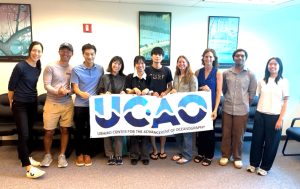
Group photo of exchange students (center), accompanying faculty member, Masami (fourth from left), and UC·AO faculty members
©Copyright ulo.fish.houdai.ac.jp All Right Reserved.