
We asked the students participating in the Instructor-Led Research Experience (ILRE) to share their experiences during their stay. Currently, three students from the School/Graduate School of Fisheries Sciences are staying at the University of Hawaiʻi at Mānoa, where they are gaining hands-on research experience.
Words & Photo:Yu Komazawa Updated:9/28
Aloha!
I am Yu Komazawa, a senior in the School of Fisheries Sciences. Three weeks have already passed since I joined the ILRE program. Currently, I am using GOTM (General Ocean Turbulence Model) to simulate upper-ocean turbulent mixing processes driven by air-sea interactions.
That sounds a bit technical, but put simply, I use just a single laptop to calculate and visualize “how seawater mixes beneath the surface in various ocean environments.”
Up until last week, I was using test data to calculate time-series changes across various parameters and plot the results. This week, I finally took on comparative experiments by slightly tweaking the numerical parameter values in the data.
What exactly does a comparative experiment look like? For example, let’s adjust one parameter: “seawater clarity.” When seawater becomes murky, sunlight entering the water can’t reach deep below the surface, causing the top layer to warm up more easily. On the other hand, the layers underneath receive less light and don’t warm up as much. Beyond clarity, the model allows us to change many other parameters—such as air temperature, wind speed, and humidity—making it possible to replicate almost any environment on Earth.
While I am currently working with test data, my ultimate goal is to gather data through my own field observations and compare the two sets. By comparing model outputs with real-world observations, we can deepen our understanding of observed phenomena and improve the model’s accuracy and reproducibility.
Next week is my final week, which means the final presentation is right around the corner. I hope to present my research findings as a token of my appreciation to everyone who helped me along the way, including Dr. Seo (photo) and the postdocs who guided me through the model from the ground up.
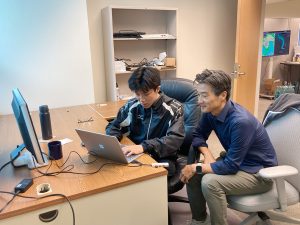
Discussing model results with Dr. Seo
~ ~ ~ ~ ~ ~ ~ ~ ~ ~ ~ ~
Words & Photo:Tsuyoshi Kubota Updated:9/17
Aloha!
My name is Tsuyoshi Kubota, and I am a first-year Master’s student at the Graduate School of Fisheries Sciences. It has been two weeks since I arrived in Hawaiʻi. I would like to introduce my life and research activities so far.
I am currently working with Associate Professor Nyssa Silbiger and participating in research activities related to coral reef ecology. As part of the research activities, I have also participated in fieldwork in intertidal and subtidal areas. During the first week, there was no fieldwork because of the effects of the hurricane. However, during the second week, the weather was good, so I participated in fieldwork for three consecutive days. I learned that fieldwork is greatly affected by weather and tidal conditions, and plans can change more often than I expected. Through this experience, I realized how challenging it can be to conduct research in the field.
During the first week, I learned coral photogrammetry and coral tracing. First, we take multiple photographs of corals and use them to create 3D models. Then, we trace each individual coral on the computer and measure its surface area. These data are used to investigate how differences in coral species and combinations affect coral growth. In the future, I plan to use R to visualize the data and examine how coral biodiversity affects coral growth.
I also participated in a volunteer activity at a taro field. Taro is a traditional staple of the native cuisine of Hawaiʻi. I was able to see how taro is grown in a flooded field. During the activity, we removed weeds that were not needed for taro growth and added soil around the plants to help prevent the stems from breaking. I also learned about taro from the people working there, which gave me an opportunity to learn more about Hawaiʻi’s natural environment, land use, and culture.
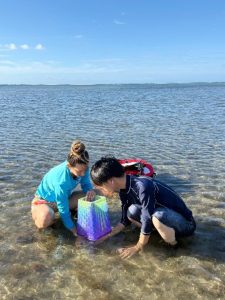
Installing equipment to measure water temperature and light at Maunalua Bay
~ ~ ~ ~ ~ ~ ~ ~ ~ ~ ~ ~
Words & Photo:Hironori Misasaka Updated:9/14
Aloha!
My name is Hironori Miyasaka, and I am a second-year Master’s student at the Graduate School of Fisheries Sciences. I am participating in Instructor-Led Research Experience, a four-week program that began on August 31 at the University of Hawaiʻi at Mānoa, where I am conducting research in marine science.
My current research focuses on the relationship between oceanic mesoscale eddies in the North Pacific and phytoplankton. This research involves a wide range of fields, including physical, chemical, and biological oceanography, with a particular emphasis on physical processes. Dr. Yoshida, who is supervising me during this program, and Dr. Qiu, who joins our weekly meetings, are both experts in physical oceanography. During this week’s meeting, they provided me with specific advice on the physical aspects of my research and statistical analysis. I can already feel my research developing further, and I am very excited to see where it leads.
Besides research, students and faculty members enjoy playing various sports, including soccer and cricket on the grassy areas around campus. I joined a soccer game right away, and it was a great way to refresh myself. Apparently, kendama has recently become popular here as well, and some students performed incredible tricks that I had never seen before. Every spectacular aerial trick drew huge cheers, creating a lively atmosphere that felt very American to me!
Although bad weather had been forecast due to an approaching hurricane, the weather has remained calm so far! We were able to explore the city and go shopping this weekend.
During the remaining three weeks, I hope not only to focus on my research and interact with people on campus, but also to experience Hawaiʻi’s unique culture and natural environment.
Shoots den!
(A casual way of saying goodbye that a cheerful UH student taught me.)
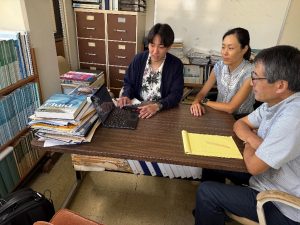
A research meeting. From left: me, Dr. Yoshida, and Dr. Qiu
~ ~ ~ ~ ~ ~ ~ ~ ~ ~ ~ ~
🌴Updated:9/10
Hironori Miyasaka and Tsuyoshi Kubota and Yu Komazawa, from the Graduate School/School of Fisheries Sciences, Hokkaido University, have arrived at the University of Hawaiʻi at Mānoa to participate in the Instructor-Led Research Experience (ILRE), the second phase of the exchange study program hosted by the University of Hawaiʻi. During this 4-week program, each student will join the laboratories of faculty members at the Uehiro Center for the Advancement of Oceanography (UC•AO)—Dr. Seo, Dr. Silbiger, and Dr. Yoshida—to conduct their research.
On the first day, a welcome lunch was held following the orientation. The lunch provided an opportunity to interact with UH faculty and students, including the ILRE faculty, UC•AO Director McManus, UC•AO graduate student fellows, as well as Shuka Morimoto and Yuki Tachibana, who are participating in the HIMB program. Afterward, the students took a tour of the ILRE faculty members’ labs and checked into Lincoln Hall, an on-campus accommodation facility at the University of Hawaiʻi where they will be staying for the next four weeks.
On the second day, the students split into their respective laboratories and began their research activities. Hironori Miyasaka held discussions not only with his supervisor, Dr. Yoshida, but also with Dr. Qiu, to flesh out the details of his new research topic at the University of Hawaiʻi. Tsuyoshi Kubota had planned to go on field research right away, but it was postponed due to a nearby hurricane, so he started his work with data analysis in the lab instead. Yu Komazawa began by setting up his computer environment to analyze satellite observation data and model outputs. Reports from each student will be shared in the future.
Hiromichi Ueno
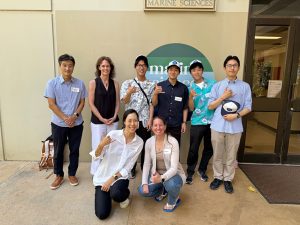
ILRE participants and instructors
©Copyright ulo.fish.houdai.ac.jp All Right Reserved.