
Students studying at the Hawaiʻi Institute of Marine Biology share their experiences! Two Graduate School of Fisheries Sciences students are taking the course “Remote Sensing Applications in Marine Science.”
What I Saw When I Entered the Ocean I Had Been Studying from Satellite Images(Updated on Sept 30)
Yuki Tachibana, 1st year Master’s program, Graduate School of Fisheries Sciences
In Hawaiʻi, I am learning about remote sensing, which uses satellites to observe the ocean. I had hardly ever spent much time looking closely at satellite imagery before, so I was amazed by how much of the ocean and coral reefs could be seen all at once. But what makes this course especially interesting is that the learning does not end on the screen. A few days later, we actually entered the ocean ourselves and observed how much coral and algae were present within designated areas.
Field observations were much harder than I had imagined. We spent more than an hour swimming while making observations, and on windy days the waves were high and the water felt cold. My body was constantly being moved by the waves, and I also had to be careful not to damage the coral. At one point, I was stung by something that seemed like a jellyfish, which was quite painful. Even so, observing the ocean with my own eyes and recording what I saw on site felt new and exciting, and my curiosity to “see more” outweighed the difficulty.
On a satellite image, the ocean can be viewed across a wide area as a single image. In the field, however, we had to distinguish and record coral and algae one by one while being moved by the waves. I realized that even when looking at the same ocean, the area and level of detail we can observe are completely different depending on the method we use.
Satellites allow us to see the ocean broadly from above, while field observations allow us to examine individual places in detail. Rather than relying on only one of these approaches, combining information from both helps the picture of the ocean gradually become clearer. I found that way of thinking very interesting.
In this course, I also listened to students who study subjects very different from mine, including whales, coral, and plankton. Even when we are looking at the same ocean, different research questions can completely change what we see. Every time I realized that there was still another version of the ocean that I had not yet noticed, I wanted to learn more.
There is an ocean that becomes visible when we look from space.
There is another ocean that we can only see by entering it ourselves.
And there is yet another ocean that becomes visible through the questions asked by someone with a different perspective.
Through this course, I feel that I have gained not only another way of looking at the ocean, but also another way of looking at the world around me.
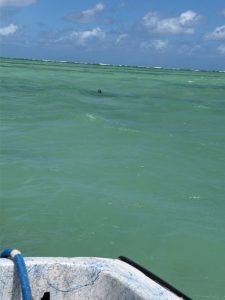
A sea turtle encountered during fieldwork. It was a large individual, approximately 2 m long.
~ ~ ~ ~ ~ ~ ~ ~ ~ ~ ~ ~
A New Learning Experience in Hawaiʻi(Updated on Sept 16)
Shuka Morimoto, 1st-year Master’s student, Graduate School of Fisheries Sciences
I study marine environmental science, with a particular focus on harmful algal blooms in Hokkaido. I am currently taking “Marine Remote Sensing Applications in Marine Science (MBIO 630)” at the Hawaiʻi Institute of Marine Biology, the University of Hawaiʻi, where I am learning about remote sensing and GIS applications in marine science.
In my first week, we studied the fundamentals of satellite remote sensing, practiced GIS analysis using ArcGIS, participated in discussions, and conducted fieldwork in Kāneʻohe Bay. Since I also use multispectral imagery in my own research, I was especially interested in learning about the spectral characteristics of water, algae, and coral.
At the same time, following technical lectures and practical exercises in English has been challenging. To improve, I have started reading lecture materials and papers in advance and checking unfamiliar words before class. This preparation helped me participate more actively, and I was able to explain in English how I would like to apply remote sensing to my own research.
Although there is still a lot for me to learn, I feel that I am gradually becoming more comfortable participating in the course. I hope to continue preparing carefully, asking questions, and making the most of this valuable opportunity.
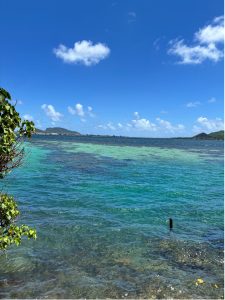
(Coconut Island)
~ ~ ~ ~ ~ ~ ~ ~ ~ ~ ~ ~
Waikīkī’s “Visible Waves” and the “Invisible Waves” I Study(Updated on Sept 14)
Yuki Tachibana, 1st year Master’s program, Graduate School of Fisheries Sciences
I study physical oceanography, and my research focuses on waves in the ocean. However, the waves I usually study are very different from the ones breaking right in front of me at Waikīkī. They are much larger-scale waves that travel along coastlines and continental shelves over periods of several days, and they cannot be seen directly just by looking at the sea surface.
The other day, I was watching people surf at Waikīkī Beach. Whenever a wave came in, the surfers would suddenly start moving, catch it, and ride toward the shore. I had come to Waikīkī as a visitor, but before I knew it, I was thinking almost entirely about the waves. Right in front of me, people were riding and enjoying waves that anyone could see. At the same time, that very same ocean also contains much larger waves that are invisible to us but still exist and influence ocean currents. I found it fascinating that phenomena with completely different time and spatial scales could all be described by the same simple word: “waves,” and could exist within the same ocean. And I felt genuinely happy that I was studying one small part of that ocean.
When I am in the lab, I often spend my time looking at the ocean through numbers and graphs. But standing in front of the real ocean at Waikīkī reminded me that the data I analyze every day represent phenomena that are actually happening in the sea right in front of me. For a moment, my research no longer felt like something that existed only inside datasets—it felt directly connected to the world I was looking at. I think I do not simply like looking at the ocean. I also like wondering, “what is actually happening inside this sea?” Beyond what we can see, there is still an entire world that I do not yet understand. Being able to uncover that world little by little may be what makes research so exciting to me.
Watching the waves at Waikīkī made me want to understand the ocean even more. It also made me want to become someone who can share the fascinating parts of the ocean that cannot be seen with the naked eye.
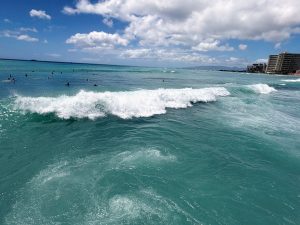
The waves at Waikīkī Beach
~ ~ ~ ~ ~ ~ ~ ~ ~ ~ ~ ~
🌴Updated 9/9
Shuka Morimoto and Yuki Tachibana, graduate students from the Graduate School of Fisheries Sciences at Hokkaido University, arrived in Hawaiʻi for a five-week stay to participate in the first student exchange program offered at the University of Hawaiʻi, “Remote Sensing Applications in Marine Science”. Prior to the start of the program at the Hawaii Institute of Marine Biology (HIMB), the students visited the University of Hawaiʻi at Mānoa and attended an orientation with faculty members from the Uehiro Center for the Advancement of Oceanography (UC・AO). During the orientation, the students received information about the upcoming program and their life in Hawaiʻi and had the opportunity to meet and interact with faculty members. After the orientation, they enjoyed lunch together and were given a tour of the university campus. Following their visit to the University of Hawaiʻi at Mānoa, the students traveled to Kāneʻohe, where HIMB is located, to begin their five-week program.
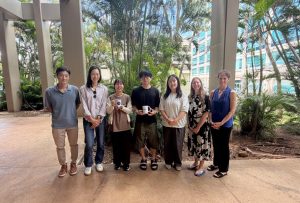
Group photo of Hokkaido University students, accompanying faculty member (Son), and UCAO faculty
©Copyright ulo.fish.houdai.ac.jp All Right Reserved.