
Students share what they learned on the final day(Updated:8/22)
Today was the last day of the Usujiri field course! The students gave presentations on what they learned throughout the course. All the Fisheries Sciences students also presented in English!
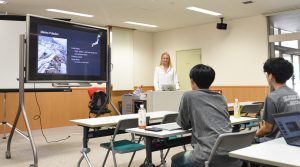
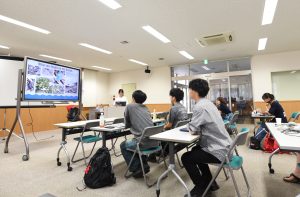
Students’ presentations
~ ~ ~ ~ ~ ~ ~ ~ ~ ~ ~ ~
Students practiced eDNA analysis and data interpretation(Updated:8/21)
Today, the students analyzed eDNA samples using water collected off Usujiri. In the afternoon, they learned how to interpret the results. Tomorrow, they will present the topics they chose and go on an excursion. We have one more day left in the course!
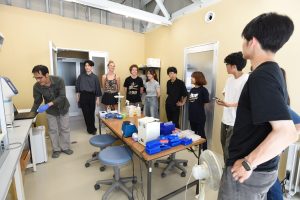
Project Associate Prof. Kawakami explaining the eDNA analysis results
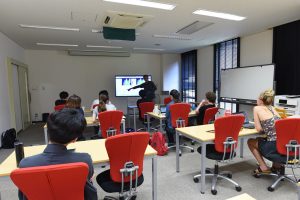
Project Associate Prof. Kawakami leading an eDNA data analysis exercise
~ ~ ~ ~ ~ ~ ~ ~ ~ ~ ~ ~
Students learn physical oceanography data analysis and Jomon culture(Updated:8/20)
In the morning, the students analyzed ocean wave data recorded off Ususjiri. In the afternoon, we visited the Hakodate Jōmon Culture Center and Kakinoshima Site, one of the World Heritage Sites of Japan. Tomorrow, the students’ll learn about the environmental DNA (eDNA) analysis at Hakodate Campus.
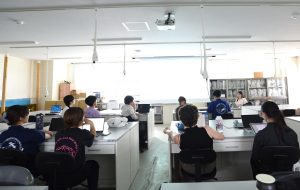
Lecture on ocean wave analysis by Project Assistant Prof. Son
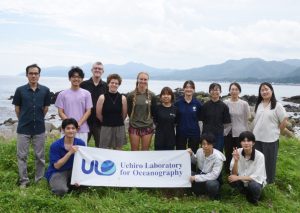
Group photo at Usujiri
~ ~ ~ ~ ~ ~ ~ ~ ~ ~ ~ ~
Learning the basic oceanographic observation(Updated:8/20)
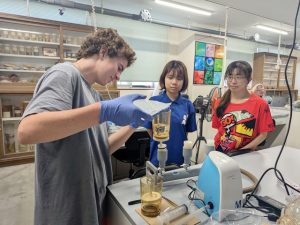
In oceanographic observation, a variety of equipment is used, including plankton nets, water samplers, and data loggers for physical oceanography. Therefore, to learn the basics of the observation, the students learn how to use these survey equipments in an actual shipboard survey as a part of this field course.
Although the waves were somewhat high and the boat swelled due to the rough weather condition, everyone safely completed the survey. After returning to the laboratory, the students observed the collected plankton samples using microscopes and cameras, and filtered seawater samples for environmental DNA analysis.
In this course, students will also learn a series of data analysis, including eDNA detection using PCR and the analysis of wave data collected during the survey.
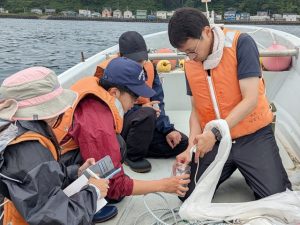
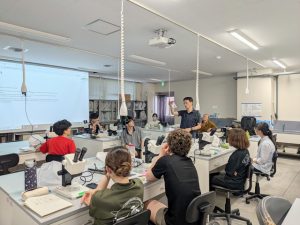
~ ~ ~ ~ ~ ~ ~ ~ ~ ~ ~ ~
Learning about the rocky intertidal ecology: A lecture and fieldwork(Updated:8/19)
During the morning of the second day, the two groups took part in different activities. One group went out by boat to collect samples for environmental DNA (eDNA) analysis and retrieve temperature sensors that had been deployed on the seafloor on the first day. The other group attended a lecture on rocky intertidal ecology, followed by fieldwork in which they explored the intertidal zone and collected and observed organisms.
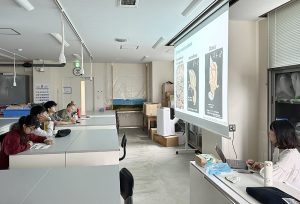
Lecture on rocky intertidal ecology by Project Assistant Prof Tamechika
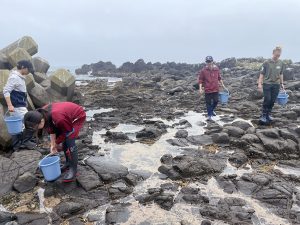
Students conducting fieldwork in the intertidal zone
~ ~ ~ ~ ~ ~ ~ ~ ~ ~ ~ ~
(Updated:8/16)
The Usujiri field course “Current issues in marine environments and their monitoring methods” has begun with two students from the University of Hawaiʻi and six students from Fisheries Sciences.
Today we held an orientation about the course. Tomorrow, we will move to the Usujiri Fisheries Station, where we will begin fieldwork and lectures.
Wishing us good weather for the course!
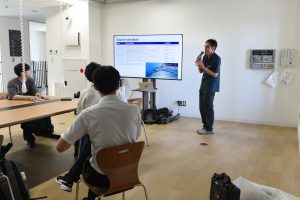
Course orientation by Project Associate Prof Kawakami
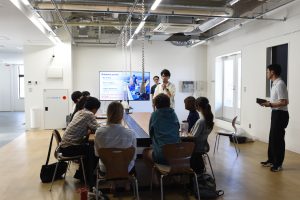
Students introducing themselves
©Copyright ulo.fish.houdai.ac.jp All Right Reserved.