
Dr. Son is now on board the T/S OSHORO MARU, conducting research. Updates from the cruise will be posted!
A University of Hawaiʻi student shares her experience aboard the ship!
An Arctic Voyage through the Eyes of a University of Hawaiʻi Student(Updated:8/6)
Kyoko Suzuki
Floating on the horizon in the midst of the fog, I saw Mt. Hakodate today. This was the first time that I saw land in the three weeks we sailed through the Arctic and the Pacific Ocean. We left Nome, Alaska in the beginning of July, passing through the Bering Strait, and heading due north to the Arctic ice edge above 70 degree latitude. It’s July. It’s almost 0 degrees outside and we can only see 100m ahead of us. All of a sudden the sea ice appears out of nowhere. It was a bizarre experience.
Before we left, the University of Hawaiʻi study abroad advisor asked me what I would miss the most. The first thing that came to mind was land. At that moment, I was imagining that I would feel somewhat isolated in the middle of the ocean with no landmarks, no community, and no civilization.
It turned out, it was the opposite. In the middle of the Arctic, I was surrounded by both the thriving community in the water and warm cruise mates onboard – let alone the countless breathtaking views and memorable moments that I cannot put into words. The vast ocean spreads in front of me with a defined horizon and a sun that never sets.
Of course, I learned practical skills for marine observations. However, what I will always remember from this cruise is the way this group of strangers came together. We eat together, we clean together, and after the observations are completed, we end the day together with laughter and all the snacks we can find. OSHORO-MARU has such a great community – not just one brought together for research but a community where everyone is bonded by a shared madness to cross into the Arctic Circle.
It’s still hard to believe that I was able to be a part of this Arctic research community. It was as if I was living in a dream, being surrounded by my role models. This experience has reminded me about the passion I have for research after a long stint of uncertainty about my place in the STEM community. But I can confidently say that the Arctic cruise has convinced me that I belong here, not just on an RV but with the people who make it a home.
This could not have been done without the support of my loving family, my friends, my labmates, and my mentor Dr. Justin Suca.
And if you are wondering whether I ever missed the land, I’ll simply say no and how I now will dream about going back to the Arctic with this team.
~ ~ ~ ~ ~ ~ ~ ~ ~ ~ ~ ~
Understanding Arctic Ocean Circulation Through Observation(Updated:7/28)
The latter part of the Leg 2 cruise consists of a series of lectures, with each day focusing on a different scientific topic. The first lecture introduced students to physical oceanography, covering the ongoing decline of Arctic sea ice and its implications for people living in the mid-latitudes of the Northern Hemisphere. During the afternoon practical session, students analyzed in situ observational data to explore the pathways of different water masses and understand their physical characteristics. By examining temperature and salinity distributions, they learned how to distinguish various water masses and trace their circulation within the Arctic Ocean. Throughout the cruise, students also collected biological samples to investigate the distribution of phytoplankton and zooplankton. On the final day of the voyage, they will present their findings, highlighting how the composition of these organisms varies with latitude and among different water masses.
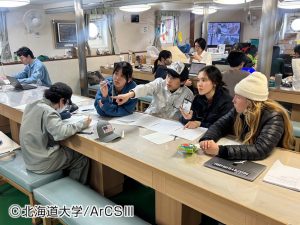
Students are talking about water properties by making T-S diagram.
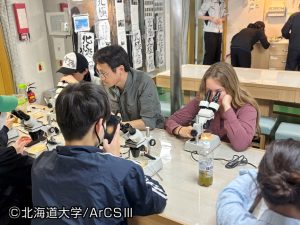
Students observing zooplankton from NORPAC net using microscope.
~ ~ ~ ~ ~ ~ ~ ~ ~ ~ ~ ~
A University of Hawaiʻi student shares her onboard experience!
An Arctic Voyage through the Eyes of a University of Hawaiʻi Student(Updated:7/23)
Ruby Helmuth
There is no other word to describe the Arctic Cruise besides exceptional. Each day I have found myself learning fascinating things about the Arctic Ocean. With every instrumental deployment, I am building a strong foundation in practical and advanced skills that aid in my understanding of oceanography. The researchers and crew whom I have the privilege to work with are beautifully weaving together their specialties to provide a comprehensive training program unlike any other I have been a part of. Furthermore, the OSHORO MARU is home to a kind and compassionate community, one that fosters friendship and mentorship by emphasizing humanity within the scientific field. Together we watch the sunset, share drinks and snacks, and dance to keep warm. The Arctic is what brought me to this program, but I have come to realize that it is the ship full of people who I will remember the most. With that, I can confidently share that this ship brings the heart of Japan to the Arctic Ocean.
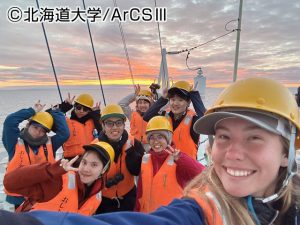
Group photo on the compass deck.
~ ~ ~ ~ ~ ~ ~ ~ ~ ~ ~ ~
MOHT Observation(Updated:7/21)
A MOHT (Matsuda, Oozeki & Hu Midwater Trawl) survey was conducted using a specialized frame trawl designed to collect juvenile and mesopelagic fish, as well as zooplankton. The operation yielded a bucketful of biological samples. The collected material contained large amounts of algae and gelatinous substances produced by zooplankton. Students therefore carefully sorted through the samples to extract fish larvae and eggs from the surrounding material. The selected specimens were preserved in ethanol and will be examined in greater detail after the vessel returns to Hakodate.
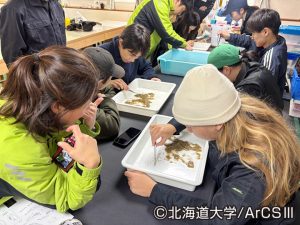
Students sorting the collected samples.
~ ~ ~ ~ ~ ~ ~ ~ ~ ~ ~ ~
Sea Ice Sampling at the Northernmost Station(Updated:7/17)
At the northernmost station of the cruise, T/S OSHORO MARU successfully collected seven sea ice samples for scientific observations at 70°- 30’N. The sea ice samples measured approximately 1.0–1.5 m in width and 0.2–0.5 m in thickness, with temperatures at their centers ranging from 0 to −1.3°C. University of Hawaii students and the open training students measured the size and salinity of each sample, gaining hands-on experience with Arctic sea ice research. After the measurements, each sea ice sample was divided into smaller pieces and sealed for preservation. Some of the collected sea ice will be melted and used in future student experiments, allowing participants to further study the physical and chemical properties of Arctic sea ice.
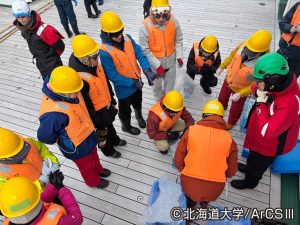
Students measuring the size and salinity of sea ice.
~ ~ ~ ~ ~ ~ ~ ~ ~ ~ ~ ~
Crew change in Nome, Alaska(Updated:7/13)
The crew change for the OSHORO MARU Arctic expedition took place in Nome, Alaska. During this transition, we celebrated the safe return of the Leg 1 participants and expressed our best wishes for a safe, successful, and productive voyage for the Leg 2 team as they departed for the Arctic Ocean.
The crew change also provided a valuable opportunity for participants to spend time together and enjoy the unique atmosphere of Nome. As all members of the Uehiro Oceanography Laboratory participating in the Arctic expedition were gathered in one place, we took a commemorative group photograph in front of the OSHORO MARU to mark this memorable milestone of the expedition.
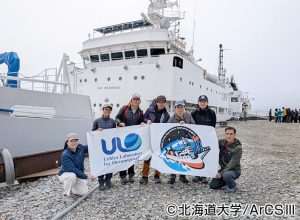
Group Photo of Uehiro Oceanography Laboratory Arctic Expedition Participants.
©Copyright ulo.fish.houdai.ac.jp All Right Reserved.