
Associate Prof Kawakami is now on board the T/S OSHORO MARU, conducting research. Updates from the cruise will be posted!
Arriving in Nome, Alaska(Updated:7/13)
Following the completion of surveys in the Bering and Chukchi Seas, the OSHORO MARU arrived in Nome, Alaska. Onboard members who participated only in the first leg of the cruise disembarked here and will return to Japan by air.
The second leg of the cruise begins with new members joining the ship, including students from the University of Hawaiʻi and universities across Japan with diverse research backgrounds, as well as oceanographic researchers.
After sharing life on board and fostering close relationships, the departing students already seem to miss the ship. This cruise surely provided them with invaluable experiences.
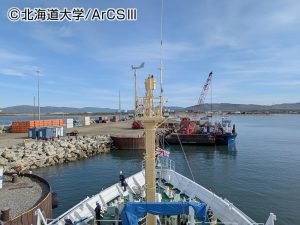
The OSHORO MARU docked at Nome. The second leg members welcomed us at the port.
~ ~ ~ ~ ~ ~ ~ ~ ~ ~ ~ ~
Entering the Arctic Ocean(Updated:7/12)
Although we had to cancel some observation stations due to the harsh weather, the observations went as planned.
The OSHORO MARU has crossed the Bering Strait, which is the Pacific gateway to the Arctic Ocean, and entered the Chukchi Sea, which is located just beyond the Bering Strait.
The “Arctic Circle” is another definition indicating the extent of the Arctic, it includes the land and is defined as the region north of latitude 66°33’N.
As the ship headed north, the seawater and air got colder and colder, and the days became longer and longer. Around the summer solstice, the sun rarely sets in the Arctic and remains above the horizon even at midnight.
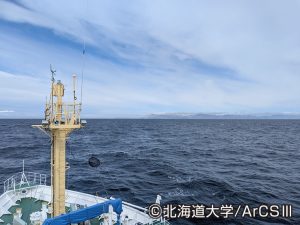
When we passed through the Bering Strait, we could clearly see the Alaskan coast.
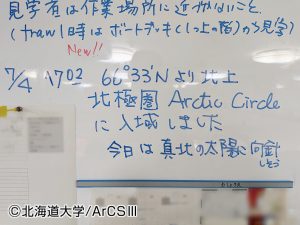
The ship crew announced our entry into the Arctic Circle.
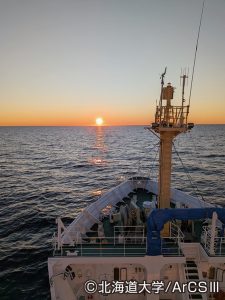
The sun does not set even around 1:00 AM. We can still see birds flying. I wonder when and where they sleep.
~ ~ ~ ~ ~ ~ ~ ~ ~ ~ ~ ~
First observation in the Bering Sea(Updated: 7/7)
After about two weeks from the departure, the OSHORO MARU has finally started its first observation in the Bering Sea.
During this cruise, various surveys are conducted at each observation station. These include CTD measurements of water temperature, salinity and other environmental conditions; water sampling for environmental DNA (eDNA) and chemical analysis; and net sampling for plankton, fish, and microplastics.
In particular, CTD measurements and water sampling are essential for oceanographic observations. During a CTD cast, the sensor is lowered to just above the seafloor to measure environmental conditions throughout the water column. Concurrently, water samples are collected from various depths using bottles installed on the CTD system.
On the OSHORO MARU, both operating the CTD and water sampling are important tasks for the students. With each observation, they become more skilled and confident in these tasks.
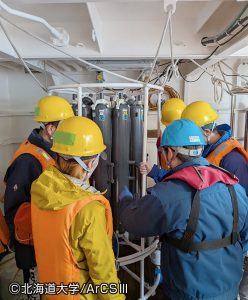
Before the observation began, a research staff explained how to operate the CTD and water sampling system.
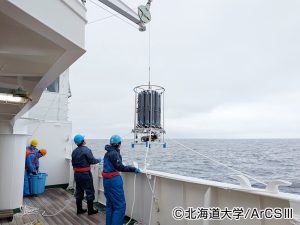
The CTD is suspended from a wire and lowered into the ocean.
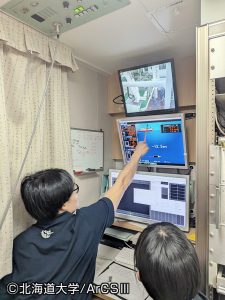
The CTD is operated from the ship. Environmental data, including temperature, salinity, and dissolved oxygen, are displayed in real time, allowing us to stop the CTD and collect water at the desired depth.
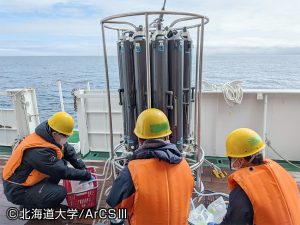
The water sampling begins as soon as the CTD is brought back on board. The sampling methods vary depending on the purpose of the research.
~ ~ ~ ~ ~ ~ ~ ~ ~ ~ ~ ~
Adjusting the ship’s clocks(Updated: 7/2)
The OSHORO MARU is heading northeast toward the Arctic.
The time lag between Japan and Alaska is minus 16 hours during daylight saving time. The ship moves much slower than an airplane, the time on the ship is adjusted gradually to match the time of the destination. As the ship heads east, the sun rises earlier and earlier. Accordingly, the ship’s clocks are advanced by one hour every few days.
Furthermore, when the ship crosses the International Date Line from west to east, the calendar moves back by one day. Therefore, the Coordinated Universal Time (UTC) is often used for the observation log. Sometimes we get confused by these time differences, so we has to be careful not to be late for meals and observation duties.
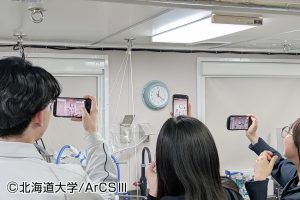
Students watching the time adjustment. On the day of a time adjustment, all ship’s clocks fast-forward at midnight, changing the time to 1:00 AM.
~ ~ ~ ~ ~ ~ ~ ~ ~ ~ ~ ~ ~ ~ ~ ~
Students’ lives on the ship(Updated: 6/30)
The OSHORO MARU is known as the “campus on the sea.” It works as a laboratory, but it also has an atmosphere like a student dormitory. As the OSHORO MARU is a training ship, unlike typical research vessels, students take turns on duty to serve meals and clean the living areas.
During their free time, they gather in the mess room to study and talk with each other. Baking bread is also one of the favorite activities on board. This lifestyle is a core part of the OSHORO MARU’s culture.
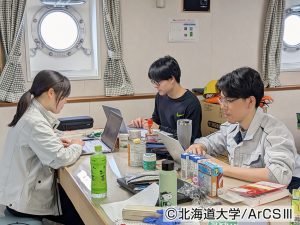
Students study hard even on board for their theses, job hunting, mastering foreign languages, etc.
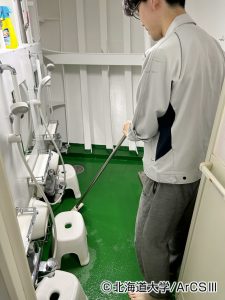
Students take turns cleaning the bathroom on their living floor.
~ ~ ~ ~ ~ ~ ~ ~ ~ ~ ~ ~ ~ ~ ~ ~
En Route to the Arctic(Updated: 6/26)
The Arctic Ocean is located far away from Japan. The distance is about 4,500 km and it takes about 10 days to get there.
Participants on the ship worked hard after departure to completely prepare their laboratories, various instruments, and fishing gear. Life on the ship has settled down and everyone seems to have gotten used to it within a few days after departure.
Before arriving in the Bering Sea, we use this opportunity of moving toward north to conduct continuous surveys of plankton and eDNA, and observations of seabirds and marine mammals. We are also holding a series of onboard seminars to share own research interests.
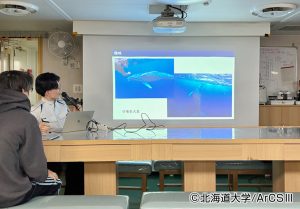
Students give presentations including self-introductions and their research projects.
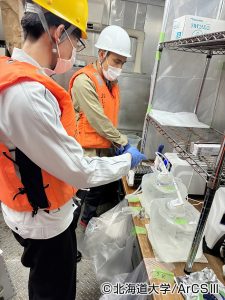
eDNA is continually sampled using an underway monitoring system.
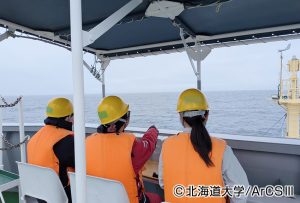
Visual observations for seabirds and marine mammals are continuing from the upper deck.
~ ~ ~ ~ ~ ~ ~ ~ ~ ~ ~ ~ ~ ~ ~ ~
Departure from Hakodate(Updated: June 24)
On 19th June, the OSHORO MARU has safely departed from Hakodate, heading to the Arctic Ocean, which is much colder and still covered by sea ice.
Despite the difficult circumstances, the tremendous efforts of everyone involved made this cruise possible.
This is my fifth-Arctic cruise, and my primary purpose on this cruise is to reveal the distribution and diversity changes in Arctic fish under ongoing climate change. To achieve this goal, environmental DNA samples and hydroacoustic data will be collected from the Bering Sea to the Chukchi Sea.
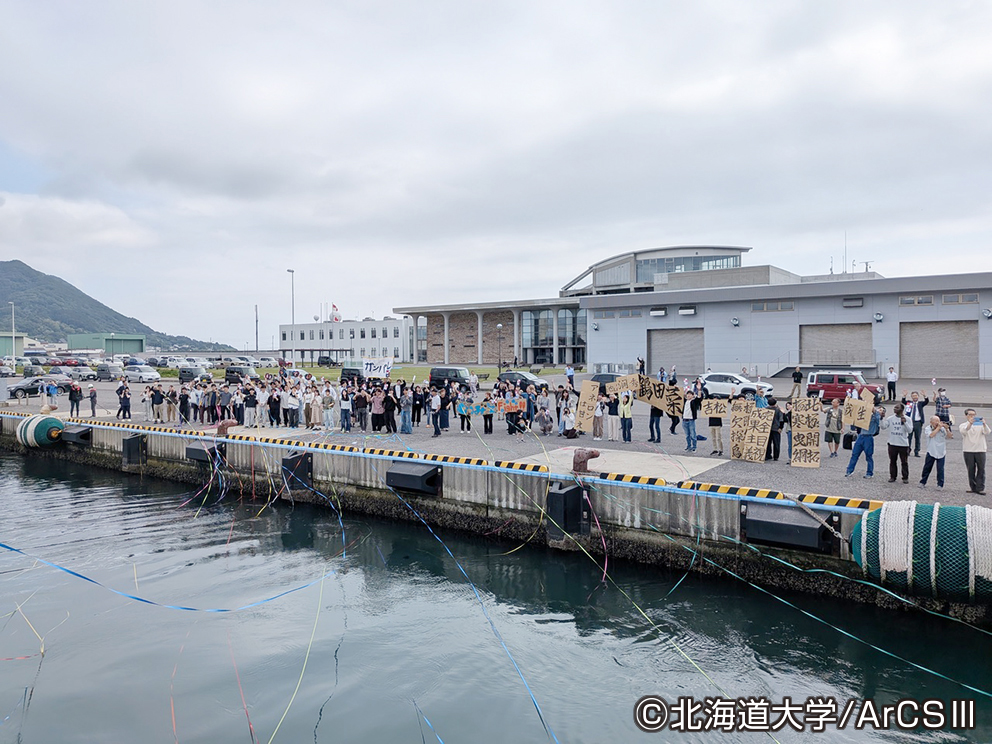
Many people gathered at the port to see off friends and colleagues as the OSHORO MARU departed from Hakodate for its Arctic cruise.
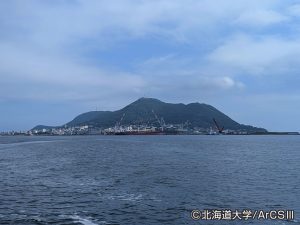
Mt. Hakodate as seen from the OSHORO MARU.
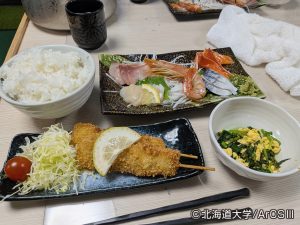
The first dinner on board. Good meals are an important part of a successful cruise.
©Copyright ulo.fish.houdai.ac.jp All Right Reserved.